

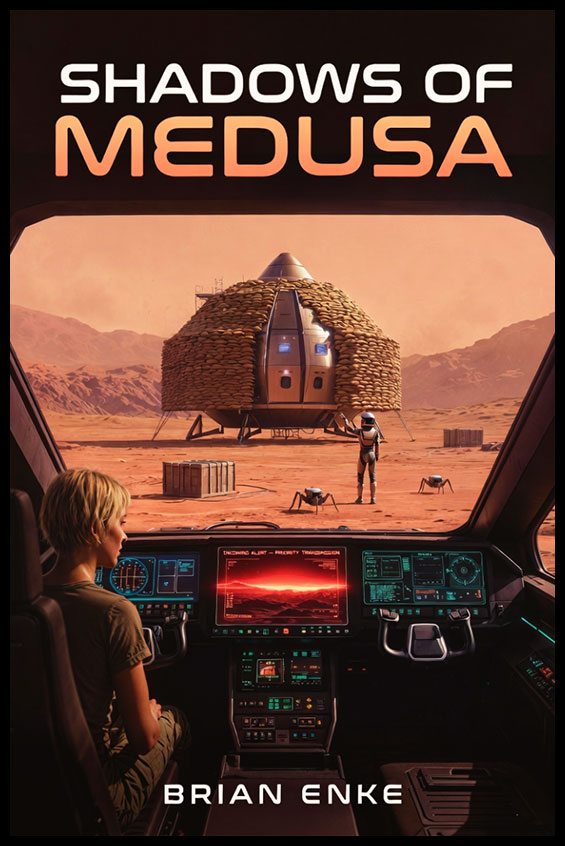
On a mission to establish humanity’s first foothold on Mars, biologist Anna Schweitzer and her small crew face the ultimate test of survival. Far from home and cut off from reliable support, they must contend with the harsh realities of the Red Planet and the growing realization that someone may want them to fail.
Meanwhile, mission support director David Debacco races to uncover the truth behind a series of suspicious incidents on Earth and in space. As he digs deeper into a web of secrecy and sabotage, he finds himself caught between his duty to the mission and his feelings for the woman he may never see again.
Shadows of Medusa is a grounded, character-driven hard science fiction novel that blends tense survival drama with an intricate conspiracy spanning Earth, Mars, and beyond.

REVIEWS
“You heard it here first: This novel is destined to be greater than K.S.Robinson’s Red Mars. The characters are complex and deeply interesting; the surroundings are vivid; the intricacies and mysteries of the plot are sewn up tight! …”
— Ms. Bobbi McCutcheon, Author: Father Mars, Mother Earth; Coauthor: Facts on File, Pioneers in Science: Space and Astronomy
“This fun, imaginatively woven science mystery about trust and love puts you in the driver’s seat of a Mars mission…”
— Bill Clancey, Florida Institute for Human and Machine Cognition
“An outstanding mystery centered around a mission to Mars. Enke’s skill as a story teller and his knowledge of space exploration are a powerful combination.”
— Mark Cohen, Author: “The Fractal Murders,” a Book Sense Top Ten Mystery.
“…the plot is fascinating and the book works as a novel. We are left eagerly awaiting more from this author.”
— The Huntsville Times, 5/15/2005
“What makes Brian’s book unique is that while he follows the adventures of the crew, he also keeps his readers attention firmly focused on this planet through the eyes of the Director of Mission Support. It is an awesome read and I highly recommend it.”
— Shannon Rupert-Robles, MiraCosta College, Director of the Mars Desert Research Station (MDRS) Remote Science Team, 3/30/2005
“… Brian Enke, has written a book, ‘Shadows of Medusa’, about a mission to Mars. My favorite line is from a scene where the crew is …[spoilers deleted]: ‘Patience. Do everything in order. Step by step, we’re settling a new world.'”
— Commander of Crew 36 at the Mars Desert Research Station, Commander’s Log, 3/13/2005.
“Best sci-fi mystery I’ve ever read.”
— Dr. Tony Muscatello, Chemical Engineer, Pioneer Astronautics; Mars Desert Research Station Director.
“A gripping adventure in the near future, Shadows of Medusa merges the speculative fiction of Larry Niven with the complex characters and plot twists of Frederick Forsythe. The book introduces the reader to the characters involved in a bold assault on the vacuum of space and the barren sands of Mars. A dedicated team on Earth and in space works together to bring the treasures of this distant planet to humankind. In the mean time, some force is interfering. Problems become hazards and alternatives are blocked off. Is it due to the risks inherent in any such dangerous endeavor with so many unknowns? Is it corruption from within? Is it an attack from outside? As each of these possibilities takes its place as the most plausible, the reader finds himself concerned very personally about the cold blackness of the space outside and the threatening thugs on the other side of the door.
This novel draws us in and holds us there from the enigmatic first paragraph to the exciting and refreshingly hopeful conclusion. Man’s most self-centered follies and his greatest aspirations are tested and resolved in this fine book and we see that Man’s better nature not only prevails but opens the door to an amazing future.”
— Julian Taylor, Author: “The Flying Crossbeam“, 1/14/2006
“Shadows of Medusa by Brian Enke is a genre-busting novel about a first manned mission to Mars. The novel is intrigue/suspense/mystery embedded within a strong and accurate framework of science/science fiction. The action shifts back and forth between the mission itself, where Anna/ and her two fellow astronauts struggle to keep their bargain basement mission on track, and mission control and Earth, where David/ tries to stay at the helm of mission control while running from the bad guys and never knowing who to trust [the good guys have chosen to remain anonymous and this adds to the mystery/confusion]. Skye, a sexy TV reporter, is this mystery’s femme fatale and one corner of the novel’s scalene love triangle. As it says in the Preface, there is a need for a sequel, so if you have issues with cliffhangers, avoid this novel. My only complaint is the price [initially $35 from the publisher] – it’s way too high for a trade paperback! I hope the price doesn’t scare away the readers Mr. Enke’s novel deserves. I enjoyed Shadows of Medusa so much I was willing to stay up until 3 in the morning in the middle of the high school standardized testing season to finish it!”
— Bruce Crocker, an Amazon.com Top 1000 Reviewer
“This book is so true to reality… this isn’t the science fiction you’re used to. Characters are deep and complex, their thoughts are inspired and their actions are fluid. Already since he began writing, much of the book has become true, like the formation of a space alliance [SEA]. He explains…”
— Red Colony webmaster, 2/27/2005.
“The clues are there, as is action and references to some familiar names. If you’ve ever pitched the Mars Direct plan, or spent some time at one of our habs, you’ll enjoy this book. If not, you might learn something about the best way to get humans to Mars. In either case, it’s a hard book to put down.”
— Mars Society webmaster, 2/20/2005.
“…Shadows of Medusa is a thought-provoking, fun mix of science and suspense which has one looking forward to the sequel.”
— The Nederland Mountain-Ear, 5/19/2005
EXCERPT
Mars Day 1, 3:50am (November 21, 12:16pm)
One more minute. Please, just one more.
Through half-closed eyes, Anna watches the bottom-right corner of her computer display. She begs the numbers on the tiny clock app to move faster. A neural feedback gadget usually sends her off to sleep within ten minutes, but it might take longer today. Too much excitement.
Soon, a two becomes a three so smoothly that she almost fails to notice.
Good. Now, one more minute.
The ritual repeats, several times.
So far, zero-G sucks. Her parabolic practice flights weren’t bad, but the doctors did warn her that the adrenaline rush of an actual launch into space might worsen her nausea. They were right.
Yet she can feel her anti-nausea medication helping, calming, and soothing her stomach’s rebellion. The meds only need to work for a few hours. Then she should be fine – or they will all be dead.
The numbers on her clock glaze over. She loses the feel of the blanket and mattress.
Anna drifts… into a nightmare. Fleeting dreams, brief but intense. Disjointed thoughts of essential tasks undone. So much to do. She had to do… what?
An eternity later, a thread of consciousness wraps itself around her and pulls her up from the depths. Then the thread breaks, leaving her trapped in that soft place between dreams and reality. Lost in a smothering darkness, her mind rehashes what she remembers of the dream.
As nightmares go, it started well: Anna was a bee. She soared through a timeless blue sky, bathed in tranquil sunlight. Updrafts helped her reach new heights. All of existence was the warmth above, a lush landscape below, and the gentle breezes between.
Abruptly, she dropped back to Earth and retook human form. She felt heavy, so heavy. Then a frantic chase, a dark shelter – and a voice, oh that voice. Familiar, yet completely wrong, vile, whispering to her, pleading to her… “You should not be here.” The story of her life.
After another eternity, she regains a better grip on reality. Bees, sky, and sunlight fade from memory, along with the oh-so-disturbing whispers and doubts. The flying part remains; it’s real. She now moves with more velocity than any bee could imagine, soaring higher than the warmest draft of air.
Her refuge, a tiny space capsule, travels five kilometers farther from Earth every second. Anna, a human bullet, speeds through a vast void toward an impossibly distant target.
The planet Mars.
Through her sluggishness, she begins to wonder about other things.
Why did I sleep on the floor?
This simple question snaps her fully awake. She recalls yesterday’s exciting launch activities, multiple rocket boosts, and spectacular views of the receding Earth. Later, nausea during a period of free-fall forced her into her quarters for a sleep shift, the first of many.
She must have forgotten to fasten her zero-G safety net. Thankfully, a blanket remains around her. Like the clothing in her wardrobe closet, its Demron-4 fabric blocks several types of low-energy radiation. Clutching it to her chest, she relishes its warmth.
Gravity anchors her to the floor. What a comfort! It is good, it is normal, and it is her stomach’s best friend. But wait – it isn’t normal after all. Its grip feels too weak.
Ah, yes. Mars gravity: 38% of Earth-normal gravity.
The presence of gravity guarantees the next steps of the mission plan have gone well. Strong tethers over a hundred meters long now link the Perseus to its second-stage rocket. Spinning the habitat and second stage around each other creates a weak simulation of artificial gravity.
During Anna’s sleep shift, her two fellow travelers must have completed the spin-up procedures. Both engineers know their craft, but no one has ever rotated a full-size, crewed, tethered vehicle. A long list of potential problems could have doomed their mission before it barely started.
Since they don’t need a biologist, EMT, or hastily-trained doctor yet, Anna feels worse than useless during these early hours of the mission. If left to roam the ship, she would probably get in the way of the engineers, driving them crazy with her worry over every little gurgle, beep, and vibration. But, in the unlikely event they do need medical attention, they know where to find her.
The only apparent problems in her artificial world are a mild new-car smell – probably in her mind – and a light bee-buzzing in her ear.
The buzzing … they ARE trying to reach me!
Lurching to her knees, she reaches for a nearby computer console but draws up short. Two-way video comms are a terrible idea right now. So instead, she touches her audio-only earpiece. The buzzing stops.
“Anna here.”
She keeps her voice low, trusting the sensitive device. If her crewmates followed their schedule to the letter, Evelyn Day should now be sleeping in the cabin below. Waking the commander on the first night of their voyage would be a mistake beyond foolish. While the food and water supplies around the sleeping bunks block radiation, the arrangement does little to dampen sound. Only a thin layer of plastic composite separates Anna’s near-floor mattress from Evelyn’s near-ceiling bunk on the level below.
A cheerful voice responds in her ear. “Good morning, Anna!”
Ollie.
The casual tone in Doctor Oliver Sainsbury’s voice allays her concerns about the mission status. Yet, his thin British accent, diluted by thirty years of living and working with Americans, startles her. She had just heard it – in her dream. It was the menacing voice in the darkness.
Oh, great. My next psych session with Kahuna is going to last for twenty years.
I’ll be old and gray before she’s through with me.
“Sorry to wake you,” continued Ollie, oblivious to Anna’s distress. “It’s time for your shift. I’m done with my task list, so get your bum up here. I need some sleep.”
Anna tries to speak, but no sound comes forth. Each word from Ollie brings back the coldness of her dream. The protective cabin walls become a mausoleum, crushing her with their weight. A six-month journey to Mars suddenly seems an endless prospect.