

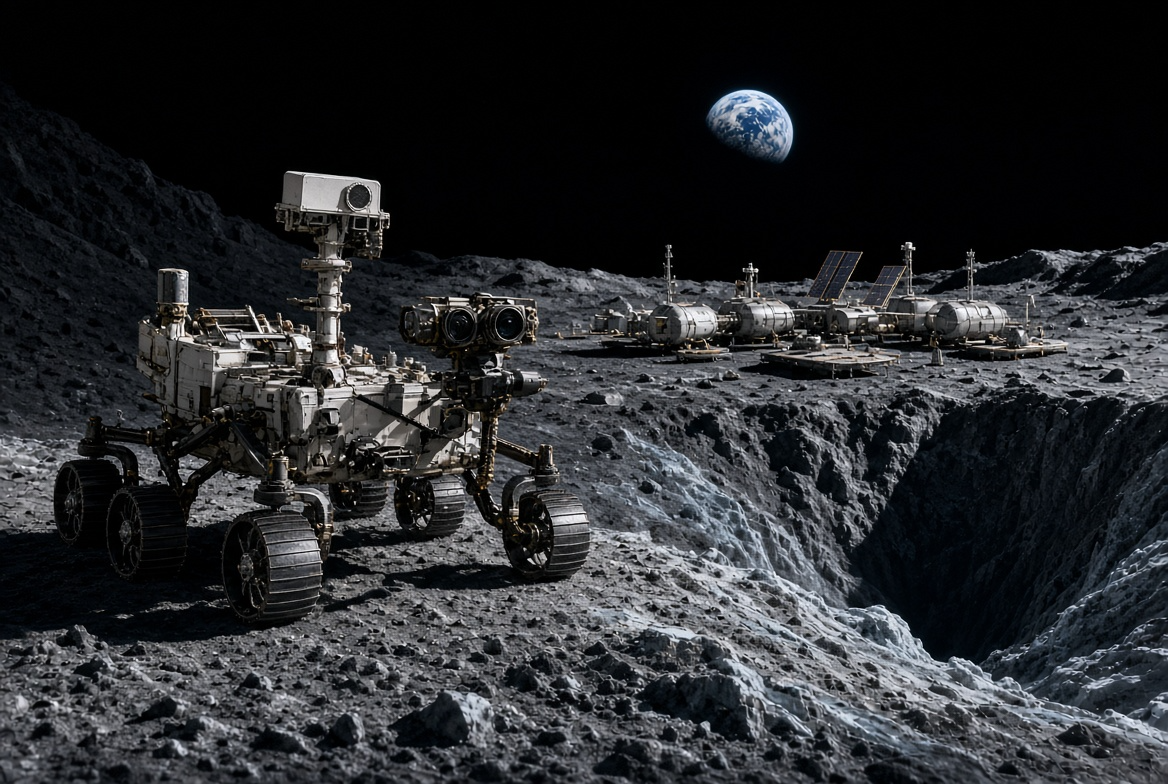
NASA’s proposal to construct a lunar rover (PROMISE) using inventory from its off-the-shelf Mars rover “pantry” has run into unexpected – and enlightening – resistance. Here are the main arguments on both sides.
Mission Calculus suggests either side could be right, depending upon their assumptions. To learn why, let’s take a deeper dive.
Context
Jared Isaacman, the current administrator of NASA, has a tough job. When he joined the agency several months ago, he set an ambitious goal to restore the 68-year-old agency’s human spaceflight mojo. NASA faces intense pressure from all sides (Congress, the American public, science communities, engineers, NewSpace companies, regulators, etc.) to achieve “more frequent wins” in space while minimizing taxpayer investment.
Unfortunately, the major stakeholders can’t agree on the problems, let alone the solutions. Isaacman entered his three-year appointment promising to make the changes he deems necessary, given his reputation as a dynamic corporate problem solver. He currently has a mandate to act swiftly and decisively… and so far, everyone seems willing to give him some room to maneuver.
He needs that maneuvering room. The NASA behemoth resembles a massive cargo ship navigating a storm at night – near a rocky, ever-changing coastline. Captain Isaacman might hit some rocky reefs over the next few years. Safe passage is not guaranteed, and he may lose valuable cargo along the way.
One of those reefs – a small but interesting one – appears to be the topic of reusing space hardware. Pundits often complain that NASA throws too much away. Whether it is hardware for space missions that never fly or test equipment for space missions that HAVE flown successfully, certain assets at the space agency become public-perception liabilities once taxpayers learn they are sitting around collecting dust. A “NASA must use (and reuse) every penny wisely” mindset leads to extreme oversight and exploding bureaucracy, which is Isaacman’s real dilemma. Keep that thought in mind as we continue.
The PROMISE rover question seems simple. Should we send old Mars test hardware to the Moon? Isaacman says yes, as long as NASA can keep the investment level low. The Planetary Society says no, citing a projected mission investment of around a billion dollars.
Who is right? Possibly both, depending on broader assumptions and on whether the right people even understand the real problem. Personally, I’m a bit skeptical. While I place a lot of faith in Isaacman as a NewSpace miracle worker, I also believe the NASA cargo ship is too heavy and too slow to avoid this particular reef.
Mission Calculus (aka Basic Math)
For those familiar with my “Mission Calculus” efforts, this section briefly recaps them. If you signed up for my mailing list, please refer to the one-page summary you received.
While writing my first novel (Shadows of Medusa), I applied my Bell Labs engineering experience toward my radical Mars mission proposal with a critical eye. I knew the novel’s novel approach (haha) to Mars exploration and settlement felt right and made intuitive sense, but as an engineer, I needed more. Real-world constraints come from basic truths that govern all space missions, and those constraints lead to insights that organically steer the plot and shape key characters’ worldviews (especially in the last two chapters).
I call these basic truths my “Mission Calculus” (formerly Space Calculus), an intentional exaggeration because the relationships can be reduced to a middle school math level. In this regard, space missions don’t have to be rocket science. The basics are meant to be duh-obvious and still fit on a single page. Seriously, this is as easy as space missions get… though the applications quickly become complicated.
Here’s the short-short version. Three main equations:
1) Goals == Capabilities
2) Complexity == (Investment * Risk)
3) Capabilities == (Complexity * TRI/B)
Discussing the Math
Let’s apply the deceptively simple Mission Calculus equations toward Isaacman’s PROMISE plan to reuse Mars hardware for lunar exploration. Right away, we run into a problem with the first equation. What are the mission goals?
I haven’t seen many details about the PROMISE goals. We can infer a lot from the acronym, though: Polar Rover for Observation, Mapping and In-Situ Exploration. NASA has never visited a lunar polar region with a rover before, so the mission sounds ambitious (and extremely useful) right out of the gate. Goals will be ambitious, and therefore, so will Capabilities (equation 1).
We encounter a bigger problem with equation 3, which I call the ‘balance’ equation. Think of Mission Calculus as a playground teeter-totter. Capabilities sit on one side, and Complexity on the other. Since an ideal mission would have maximum Capabilities and minimum Complexity, we must add sandbags to the Complexity side to keep the teeter-totter balanced. Those sandbags lie within the TRI/B term, a multiplier for Technology, Resources, Innovation, and (inverse) Bureaucracy.
The proposed off-the-shelf PROMISE rover is a one-off mission (i.e. no iteration, which normally fits into the Innovation (I) sandbag). Other than the re-use, nothing about the proposed mission seems overly Innovative. The Resources (R) sandbag won’t help the balance much either, since we’re reusing a Mars rover in a lunar resource environment with fundamentally different gravity, friction, (no) atmosphere, dust grain sizes, thermal extremes, and more.
To counter these headwinds, we must overweight the T or (inverse) B sandbags – or raise Complexity – or reduce the mission Capabilities.
Overweighting the Technology (T) sandbag seems promising at first glance, since the proposed NASA rover will run on nuclear power. Cool! Or rather, hot!
However, the oversized nuclear sandbag comes at a steep price. Any increase in T will be partially offset by an increase in B (Bureaucracy), since a NASA nuclear mission will face greater regulatory scrutiny than a non-nuclear one. Extending the teeter-totter analogy, think of bureaucrats attaching a (hot) hydrogen balloon to each nuclear sandbag. Fortunately, the overall weight of a nuclear sandbag must remain positive (or else NASA would never use nuclear power on any space mission).
The real problem with using nuclear sandbags is the effect on the Complexity term. Nuclear stuff tends to be complicated, i.e. Complexity rises. That increase may be justified on the Moon because we can directly and vastly increase the mission Capabilities, as desired. A nuclear rover can go farther and do more science, perhaps even during the cold-cold lunar nights. But… at what cost?
In equation 2, Complexity rears its ugly head. This equation also, finally, contains the all-important Investment term, aka cost. Reducing Investment is the whole point of the PROMISE proposal to re-use NASA hardware. To do so, we must either increase Risk or reduce Complexity. Note that Investment also includes ‘time’ (because on Earth or in space, time is money).
How NASA Might Succeed
To greatly reduce the mission Investment, NASA’s options are few. Accepting greater Risk is probably not feasible at NASA. Therefore, they must focus on reducing Complexity (equation 2). Everything depends upon their ability to keep the mission simple.
To keep Complexity low, TRI/B must be high, or Capabilities must be low (equation 3). As we have surmised above, going nuclear would raise TRI/B… but it would also raise Capabilities and Complexity. The equations won’t balance unless NASA can somehow conduct the mission with much less Bureaucracy.
Reducing Bureaucracy within NASA aligns with Isaacman’s management style. In response to a recent, ill-advised SpaceNews op-ed on a different subject, the administrator clearly expressed his passion for reducing Bureaucracy:
“Bureaucracy has already throttled space exploration, and this article proposes creating a UN-affiliated ‘Planetary Stewardship Council’? As a species, there are few things we actually agree upon here on Earth, so how could this possibly advance progress in space?
No. The authors incredible accomplishments aside, as a society we need fewer bureaucrats regulating tethered caps on plastic water bottles and more doers if we want to see even a glimpse of that exciting future so many of us imagined as children.
When the capabilities are there to send NASA astronauts back to the Moon and on to Mars, we will go. We will do so thoughtfully, as we always have, and we will do so for all mankind.”
A+ for Isaacman because he is correct. But can he steer the massive, nuclear NASA cargo ship with the dexterity and efficiency of a speedboat?
He must. The only other option is to reduce the mission Capabilities. Goodbye, nuclear rover.
Sending a brick to the Moon is cheap. And, it’s probably the only mission a hypothetical Planetary Stewardship Council would approve.
… and How NASA Might Fail
Now, for the other side. Let’s assume we can’t reduce NASA bureaucracy, but we still want maximum science Capabilities from PROMISE. These assumptions align with the Planetary Society’s style. Historically, they love bureaucratic things like Planetary Stewardship Councils.
Raising Bureaucracy lowers TRI/B, which raises Complexity (equation 2, again). Higher Complexity requires a much greater level of Investment or Risk (equation 3), or both.
An Unvoiced Alternative with Clear Sailing
Let’s ask a different question. In a parallel universe, if NASA’s main mission goal was to use their Mars pantry hardware as effectively as possible… maximizing the value of taxpayer dollars (or whatever buzzwords you want to use)… what should they do?
We learned above that sending the PROMISE rover to the Moon leads to TRI/B problems because the rover wasn’t designed to operate on the Moon.
Why doesn’t NASA send PROMISE to Mars, instead?
Zipping through the analysis (and comparing against the Curiosity and Perseverance Mars missions)… sending a reused rover to Mars increases Innovation, which increases TRI/B and lowers Complexity in equation 3, thereby reducing Investment or Risk (or both) in equation 2. Nice and simple. And probably impossible… because it’s all about the Moon now.
Conclusion
The Mission Calculus equations balance if NASA slashes bureaucracy or turns PROMISE into a dumb lunar brick. If they insist on lofty science goals within a business-as-usual environment, Investment will skyrocket. Since no one wants to send a brick to the moon, the remaining two outcomes lead to the Isaacman and Planetary Society positions. Either could happen.
But what is NASA’s real goal? If the real NASA goal is to optimize reuse of the Curiosity and Perseverance hardware… use it on another Mars mission. That’s a guaranteed win, but it would be a win on Mars, not on the Moon.
Let’s Start A Discussion
I hope you have enjoyed this attempt to apply the deceptively simple Mission Calculus equations to a real-world mission proposal.
Can Isaacman slash Bureaucracy at NASA? Let me know your thoughts by using the ‘Contact Me’ form.
Until next time, dear friends of the future…
- Brian