

Context
The inspiration for this blog post is a recent Substack article by Tori Shivanandan, President and Chief Operations Officer at Radiant, a company that builds nuclear fission microreactors. Please read her remarks before my comments below, if possible:
Energy Production On Mars
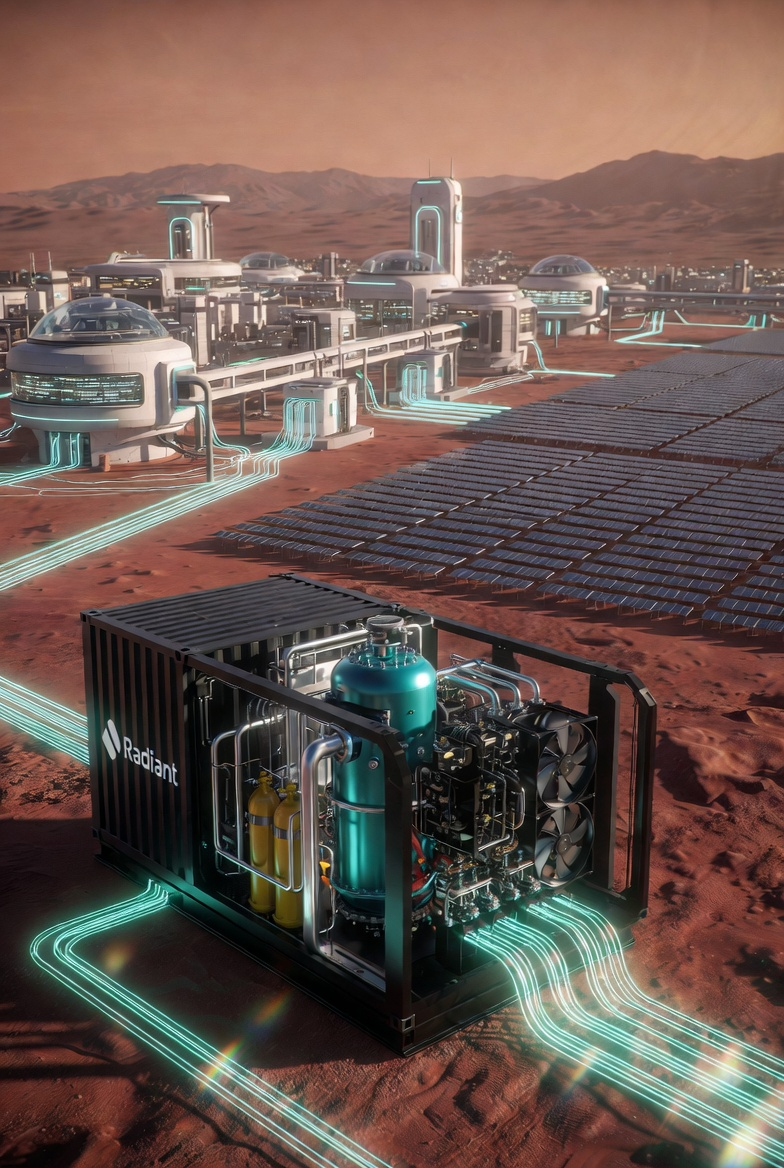
On Mars, a reliable energy supply ranks second only to water in priority. A popular saying goes, “Water is life, and energy is water.” The two energy options most often discussed are solar panels and nuclear fission reactors, while other potential sources (geothermal, nuclear fusion) draw more snickers than votes.
Solar panels could someday be manufactured on Mars, and any fool can plug a new array of panels into an existing power grid. I don’t say ‘fool’ lightly. I just did it at home yesterday, plugging my portable solar panel array into the battery hub that powers my computer equipment. If I can do it, anyone can, even while wearing a spacesuit (which I did not do).
Sure, there are potential problems… but solar panels do seem ideal for an early Mars habitat like the one described in Shadows of Medusa. Yes, I know it’s hard to believe, but I did put a lot of thought into the early base infrastructure. The mantra for those early missions is simplicity, making solar energy the obvious winner.
But… Fission! Power to the People!
I’m also a strong believer in nuclear fission… just not for early settlements. A baby learns to walk before she rides a bicycle while juggling three soda cans and stuffing baseball cards into the wheel spokes. Start simple and iterate toward improvement.
In the long run, the unrivaled energy density of nuclear fission wins, especially on Earth. One reactor can power a mid-sized city. Try doing that with solar panels without destroying the (Earth) environment because you just covered half a county with ugly silicon, battery hubs, and high-voltage power transmission lines.
One could argue that on Mars, who cares? Let’s cover the whole planet in solar panels. Well, uh, it’s actually hard to refute this argument. Theoretically, it could work. But let’s not go there today…
The nuclear industry has been sadly neglected in the United States over the past few decades, but the wheel never stops turning. Many young companies like Radiant now tout advanced reactor designs. Safer and more environmentally friendly (because they can’t melt down and will generate power where it is needed), “Small Modular Reactors” (SMRs) may soon revolutionize life on Earth and Mars if given half a chance.
There’s Trouble on Mars
Twenty years ago, the 4Frontiers Corporation conducted the most in-depth series of early Mars mission planning workshops to date. Experts across many fields debated the issues and trade-offs of various technologies. One of their conclusions about energy astonished me so much that I often mention it in public outreach talks, just to get a reaction: If we use nuclear fission as a primary power source, the first crew of six Mars explorers must include ten nuclear engineers.
Hmm. Call me a cynic, but I think I see a problem with that mission plan.
But perhaps you don’t yet believe that conclusion. That’s fine; I didn’t at first, either. Upon further review, I’m still a bit skeptical, but it sorta holds water. This is where Tori Shivanandan’s comments become relevant. She won’t need much convincing about the need for nuclear engineers on Mars… the more, the better.
Let’s Start A Discussion
Let me know your thoughts on the general topic of Martian energy by using the ‘Contact Me’ form. I’m always open to ideas and feedback. Energy concerns drive a half-written scene in Tetrahedron, so any feedback is oh-so-timely and appreciated.
Until next time, dear friends of the future…
Brian