

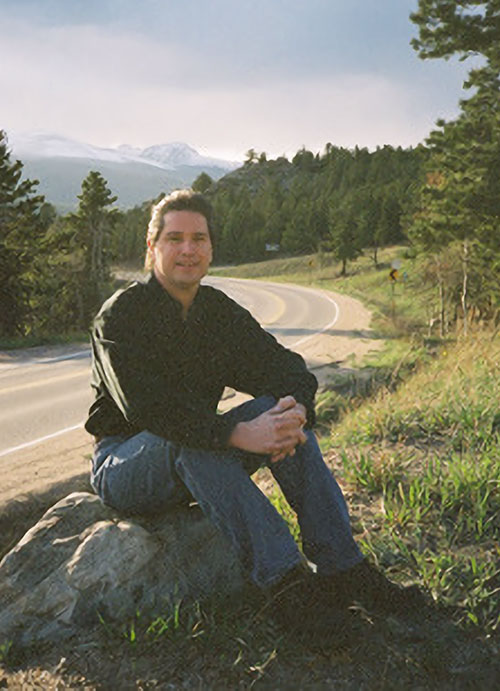
ABOUT ME
Brian Enke is a space science researcher, NewSpace consultant, mentor, and author who brings decades of hands-on experience in planetary science and complex systems to his work on Mars exploration and the future of humanity in space. Through the Velocity Saga, he combines rigorous, “hard” science fiction with real-world engineering insights—inspiring readers while grounding far-future speculation in present-day realities.
As Senior Research Analyst at the Southwest Research Institute (SwRI) in Boulder, Colorado, Brian has spent more than two decades advancing our understanding of planetary surfaces and small bodies. His research includes Mars crater and 3D surface topography studies, Pluto photometry, asteroid spectroscopy, 3D planetary imaging, AI and machine learning applications, and high-resolution asteroid impact simulations. He was also a team member on a proposal for NASA’s first Mars Settlement workshop. He regularly shares these insights through public outreach events and media appearances focused on the Moon, Mars, and asteroids.
Brian’s commitment to Mars exploration runs deep. A founding member of the Rocky Mountain Mars Society chapter (established in 1999), he has served as chapter contact and Director of Mission Support. He contributed to the construction of the Flashline Mars Arctic Research Station (FMARS) and Mars Desert Research Station (MDRS), directed multiple seasons of analog mission support, participated in spacesuit and logistics testing, and judged design competitions such as the Kepler Prize for Earth-return vehicles. He has also consulted for pioneering NewSpace organizations—including 4Frontiers Corporation, MarsDrive Consortium, and Mars One—providing technical guidance on settlement architectures. As part of that work, he developed characters, recruited prominent authors (including Ben Bova, Michael Carroll, and Marianne Dyson), and wrote two stories for the young-adult Mars anthology The Callahan Kids: Tales of Life on Mars.
Before entering the space sector, Brian spent 17 years at Bell Laboratories (AT&T and later Lucent Technologies) as a lead integrator on the 5ESS project—the most complex hardware and software integration effort in the world at the time. His main goal was to achieve “five-nines of quality” in the software update process, and he routinely surpassed it. This experience in managing extreme complexity powerfully reinforced a core lesson: space missions must be kept as simple and focused as possible. No mission creep. No “Christmas trees.” Lean and mean. That philosophy is directly reflected in the minimal, tightly scoped mission to Mars depicted in Shadows of Medusa.
In more recent years, Brian has served as lead data pipeline engineer for NASA’s New Horizons spacecraft, which flew past Pluto in 2015 and the distant Kuiper Belt object Arrokoth in 2019. Every close-up image ever returned from either encounter has passed through his pipeline. He is also a member of the downlink and archival team for the Lucy spacecraft, currently en route to multiple Trojan asteroid encounters near Jupiter. These roles have given him intimate experience with deep-space communications, precise time synchronization, and operating spacecraft at extreme distances—making even a mission to Mars feel almost local by comparison.
This body of work reflects Brian’s long-held work-life motto: “I’ve made a great career out of being the dumbest person in the room.” He has consistently found that asking the simple, obvious questions in highly complex environments often leads to the most elegant and reliable solutions.
As an author, Brian is the creator of the Velocity Saga series. Building on the acclaimed hard-SF novels Shadows of Medusa and Medusa Rising, with the third novel Tetrahedron currently in progress, the series uses compelling mystery and adventure to explore present-day Mars exploration strategies alongside far-future possibilities. His guiding principle is edutainment: embedding accurate science and engineering so seamlessly that readers absorb real knowledge while being thoroughly entertained. He believes that stories—whether in novels or games—can powerfully motivate the next generation of explorers, engineers, and innovators.
In addition to his professional work, Brian mentored Nederland High School’s FIRST Robotics teams for all 15 years starting in 2005 and mentored science projects at Berthoud High School for six years, volunteering thousands of hours to inspire young engineers and scientists through real-world project challenges. The Nederland teams achieved notable successes, including a Colorado Regional win and strong performances at the world championships, until the program concluded following the disruptions of COVID-19.
Through research, analog missions, consulting, and storytelling, Brian Enke champions the idea that humanity’s future among the stars begins with clear thinking, disciplined risk management, and an unwavering focus on simplicity—cutting through unnecessary complexity to reveal elegant, workable solutions. His work on the Velocity Saga website and series continues that mission: making the challenges and wonders of Mars exploration accessible, inspiring, and actionable for everyone.

Join Brian's Newsletter
You can unsubscribe at any time.